
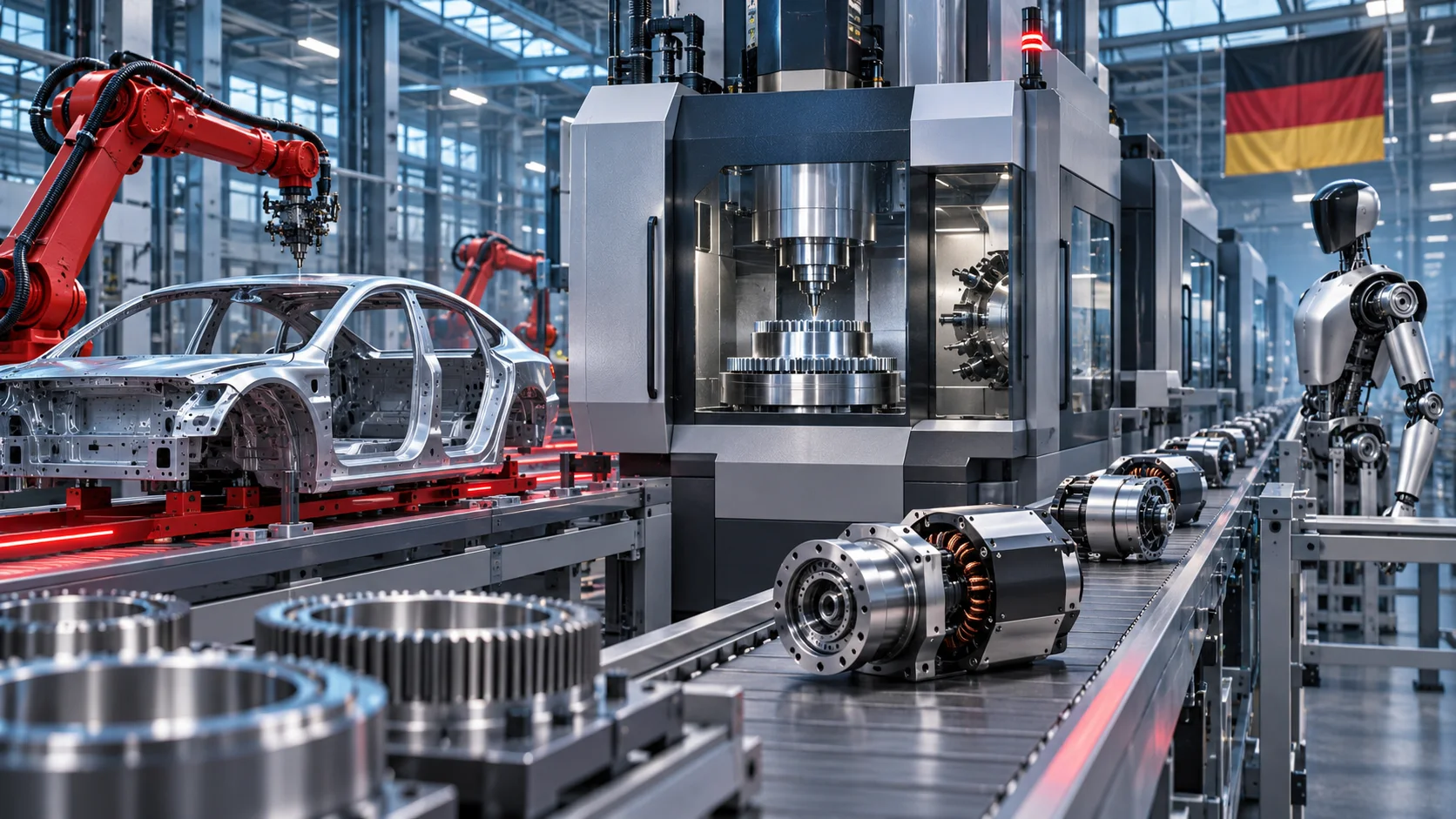
Tesla has submitted plans to acquire German manufacturing-systems group EMAG, according to a filing with Germany’s antitrust authority, potentially bringing precision machine-tool expertise closer to the electric-vehicle maker’s industrial operations.
Reuters reported the filing on Friday. Financial terms, the proposed transaction structure and the expected review timetable were not immediately disclosed. The filing signals an intended transaction; it does not mean the acquisition has closed or received regulatory clearance.
A precision-manufacturing specialist
EMAG, headquartered in Salach near Stuttgart, supplies machine tools and integrated production systems covering turning, drilling, milling, gear cutting, grinding, laser welding and electrochemical machining. The company says its systems can support complete production chains for vehicle powertrains, chassis parts and non-automotive components.
The company’s official profile describes EMAG as a global provider of modular and customized manufacturing systems. Its technology is used to produce high-precision components where repeatability and automated high-volume output are critical.
Humanoid-robot manufacturing link
EMAG has recently highlighted manufacturing systems for humanoid-robot actuators and gearboxes. In an official technical article, the company said its portfolio covers production steps for strain-wave gears, planetary gears and linear actuators, including turning, grinding, gear cutting, laser processing, measurement and automation.
That capability may be relevant to Tesla’s work on humanoid robotics as well as conventional vehicle manufacturing. Precision gears and actuators are among the most demanding mechanical parts in a humanoid robot because they must combine tight tolerances with durability and eventual mass-production economics.
However, neither the antitrust filing nor the available company disclosures specify which EMAG assets, operations or employees would be included. Any strategic link to a particular Tesla product therefore remains an inference from EMAG’s capabilities rather than a confirmed transaction term.
The proposed deal comes as Tesla expands its manufacturing technology base beyond vehicle assembly. Acquiring a specialist machine-tool supplier could give the company greater control over production equipment and process development, but the commercial effect cannot be assessed until the parties disclose the scope and price of the transaction.