
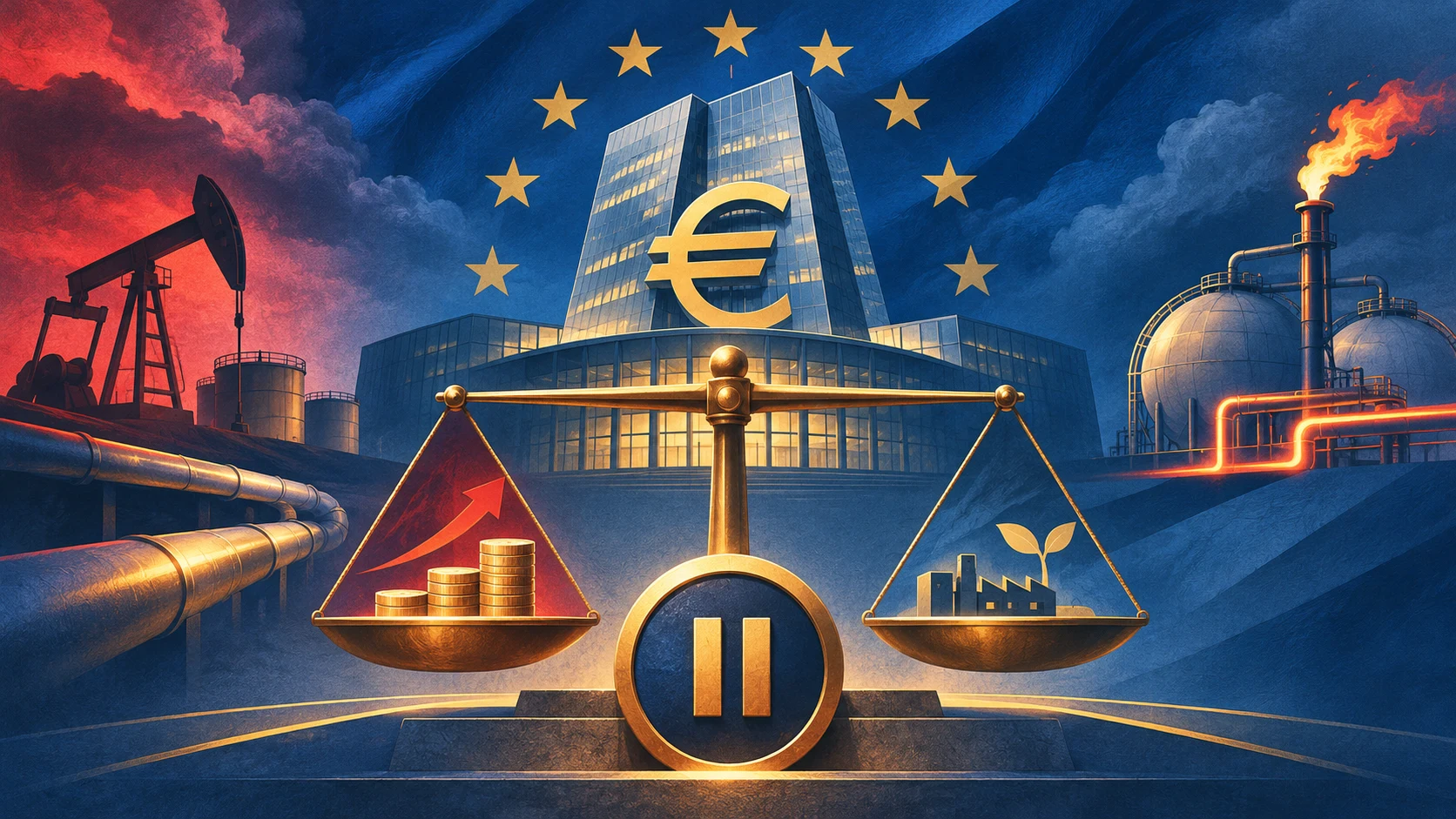
European Central Bank policymakers unanimously supported keeping interest rates unchanged in October as they weighed a renewed energy-price shock against signs that underlying inflation and wage pressures remained contained.
The account of the ECB’s October 28–29 meeting, published Thursday, said all members backed a pause after rate increases in June and September. Officials judged that unchanged rates would leave the Governing Council well positioned while the inflation and growth effects of higher energy costs remained uncertain.
Energy prices raise inflation risks
Oil and gas prices had moved above the adverse scenario in the ECB staff’s September projections, according to the account. Policymakers said the larger and more persistent energy shock could lift inflation, weaken growth and eventually produce indirect or second-round effects.
At the same time, incoming data supported a pause. Underlying inflation had remained broadly stable, wages had not shown a material response and most measures of longer-term inflation expectations were still anchored around the ECB’s 2% target.
The account said risks to growth and inflation pointed in opposite directions. Higher energy costs threatened household purchasing power and business activity, while tighter financing conditions were expected to restrain both demand and price pressures.
Meeting-by-meeting stance
The ECB kept its three key rates unchanged at the October meeting and repeated that future decisions would be data-dependent and taken meeting by meeting. The published account adds detail to the October policy decision, rather than announcing a new rate move.
Policymakers also discussed rising sovereign bond yields, fiscal dynamics and concerns about increasingly debt-financed artificial-intelligence investment. Those issues added to financial-market uncertainty but did not change the consensus to hold rates steady.
The latest account follows separate ECB data showing that annual lending growth to euro-area companies accelerated to 4.5% in October. The Governing Council’s next monetary-policy account is scheduled for January 21, 2027.